Head & Shoulders Scalp Detoxifying Pre-wash Mask Review
A caput injury is any trauma to the scalp, skull, or encephalon. The injury may be but a minor bump on the skull or a serious encephalon injury.
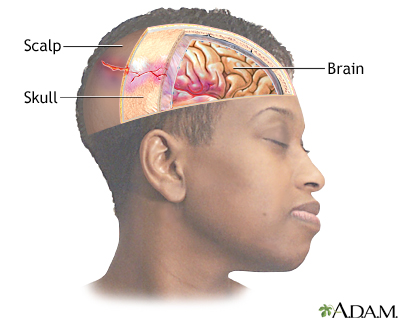
Caput injury tin be either airtight or open up (penetrating).
- A closed head injury means you received a hard blow to the head from striking an object, but the object did not interruption the skull.
- An open, or penetrating, head injury means yous were hitting with an object that broke the skull and entered the encephalon. This is more than likely to happen when you motion at high speed, such as going through the windshield during a automobile accident. It can also happen from a gunshot to the head.
Head injuries include:
- Concussion, in which the brain is shaken, is the most common blazon of traumatic encephalon injury.
- Scalp wounds.
- Skull fractures.
Head injuries may cause haemorrhage:
- In the brain tissue
- In the layers that surroundings the brain (subarachnoid hemorrhage, subdural hematoma, extradural hematoma)
Head injury is a mutual reason for an emergency room visit. A large number of people who suffer caput injuries are children. Traumatic brain injury (TBI) accounts for over 1 in vi injury-related infirmary admissions each year.
Common causes of head injury include:
- Accidents at home, work, outdoors, or while playing sports
- Falls
- Physical assault
- Traffic accidents
Most of these injuries are small-scale because the skull protects the brain. Some injuries are severe enough to crave a stay in the infirmary.
Head injuries may cause bleeding in the brain tissue and the layers that environment the brain (subarachnoid hemorrhage, subdural hematoma, epidural hematoma).
Symptoms of a head injury tin can occur right abroad or may develop slowly over several hours or days. Even if the skull is not fractured, the brain tin hit the inside of the skull and be bruised. The head may look fine, simply problems could result from bleeding or swelling inside the skull.
The spinal cord is likewise probable to be injured from falls from a significant height or ejection from a vehicle.
Some head injuries cause changes in encephalon function. This is called a traumatic brain injury. Concussion is a traumatic brain injury. Symptoms of a concussion tin can range from mild to severe.
Learning to recognize a serious caput injury and give basic offset aid tin can relieve someone's life. For a moderate to severe head injury, CALL 911 Correct AWAY.
Get medical help right abroad if the person:
- Becomes very sleepy
- Behaves abnormally, or has speech that does not brand sense
- Develops a severe headache or stiff neck
- Has a seizure
- Has pupils (the dark central part of the centre) of unequal sizes
- Is unable to motility an arm or leg
- Loses consciousness, even briefly
- Vomits more than once
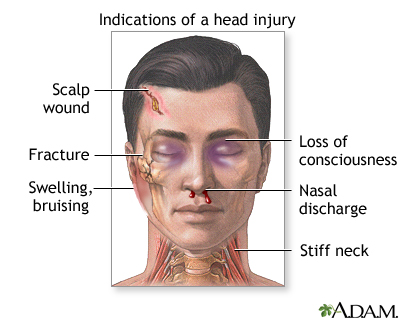
Then accept the following steps:
- Bank check the person's airway, breathing, and apportionment. If necessary, begin rescue breathing and CPR.
- If the person'south breathing and middle rate are normal, only the person is unconscious, treat every bit if at that place is a spinal injury. Stabilize the head and neck past placing your easily on both sides of the person's head. Keep the head in line with the spine and prevent motility. Wait for medical help.
- Stop whatever bleeding by firmly pressing a clean cloth on the wound. If the injury is serious, be conscientious not to movement the person's head. If blood soaks through the fabric, exercise non remove it. Place another cloth over the first ane.
- If you suspect a skull fracture, do non utilise direct pressure to the haemorrhage site, and practise not remove any debris from the wound. Cover the wound with sterile gauze dressing.
- If the person is airsickness, to forbid choking, gyre the person'due south head, neck, and body as one unit of measurement onto their side. This still protects the spine, which you must e'er assume is injured in the instance of a head injury. Children ofttimes vomit once afterwards a head injury. This may not exist a problem, merely telephone call a md for farther guidance.
- Apply ice packs to swollen areas (cover ice in a towel so information technology does not directly touch the pare).
Follow these precautions:
- Practice Non launder a caput wound that is deep or bleeding a lot.
- DO NOT remove any object sticking out of a wound.
- Practice Not move the person unless absolutely necessary.
- Practice NOT shake the person if they seem dazed.
- DO Not remove a helmet if you suspect a serious head injury.
- Exercise Non pick up a fallen child with whatever sign of head injury.
- DO Not drink alcohol within 48 hours of a serious head injury.
A serious head injury that involves bleeding or brain damage must be treated in a hospital.
For a balmy head injury, no treatment may exist needed. Withal, call for medical advice and scout for symptoms of a caput injury, which can prove upward later.
Your health care provider will explain what to wait, how to manage any headaches, how to treat your other symptoms, when to return to sports, school, work, and other activities, and signs or symptoms to worry nigh.
- Children volition need to be watched and make activity changes.
- Adults also need close observation and activity changes.
Both adults and children must follow the provider's instructions nearly when it will be possible to render to sports.
Telephone call 911 right away if:
- There is severe head or face bleeding.
- The person is confused, tired, or unconscious.
- The person stops breathing.
- Y'all suspect a serious head or neck injury, or the person develops any signs or symptoms of a serious caput injury.
Not all head injuries tin exist prevented. The post-obit elementary steps can help continue you and your child safe:
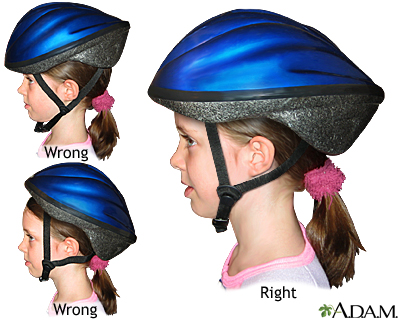
- Always use safety equipment during activities that could cause a head injury. These include seat belts, bicycle or motorbike helmets, and difficult hats.
- Larn and follow cycle safety recommendations.
- Do non drink and drive, and do not permit yourself to be driven by someone who you know or suspect has been drinking alcohol or is dumb in another way.
Brain injury; Head trauma
Hockenberry B, Pusateri Thousand, McGrew C. Sports-related head injuries. In: Kellerman RD, Rakel DP, eds. Conn's Current Therapy 2020. Philadelphia, PA: Elsevier 2020:693-697.
Hudgins E, Grady S. Initial resuscitation, prehospital intendance, and emergency room care in traumatic brain injury. In: Winn Hr, ed. Youmans and Winn Neurological Surgery. 7th ed. Philadelphia, PA: Elsevier; 2017:chap 348.
Papa Fifty, Goldberg SA. Caput trauma. In: Walls RM, Hockberger RS, Gausche-Hill M, eds. Rosen's Emergency Medicine: Concepts and Clinical Practice. 9th ed. Philadelphia, PA: Elsevier; 2018:chap 34.
Updated past: Jacob Fifty. Heller, MD, MHA, Emergency Medicine, Emeritus, Virginia Mason Medical Center, Seattle, WA. Besides reviewed by David Zieve, MD, MHA, Medical Managing director, Brenda Conaway, Editorial Director, and the A.D.A.M. Editorial team.
Source: https://medlineplus.gov/ency/article/000028.htm

Enregistrer un commentaire for "Head & Shoulders Scalp Detoxifying Pre-wash Mask Review"